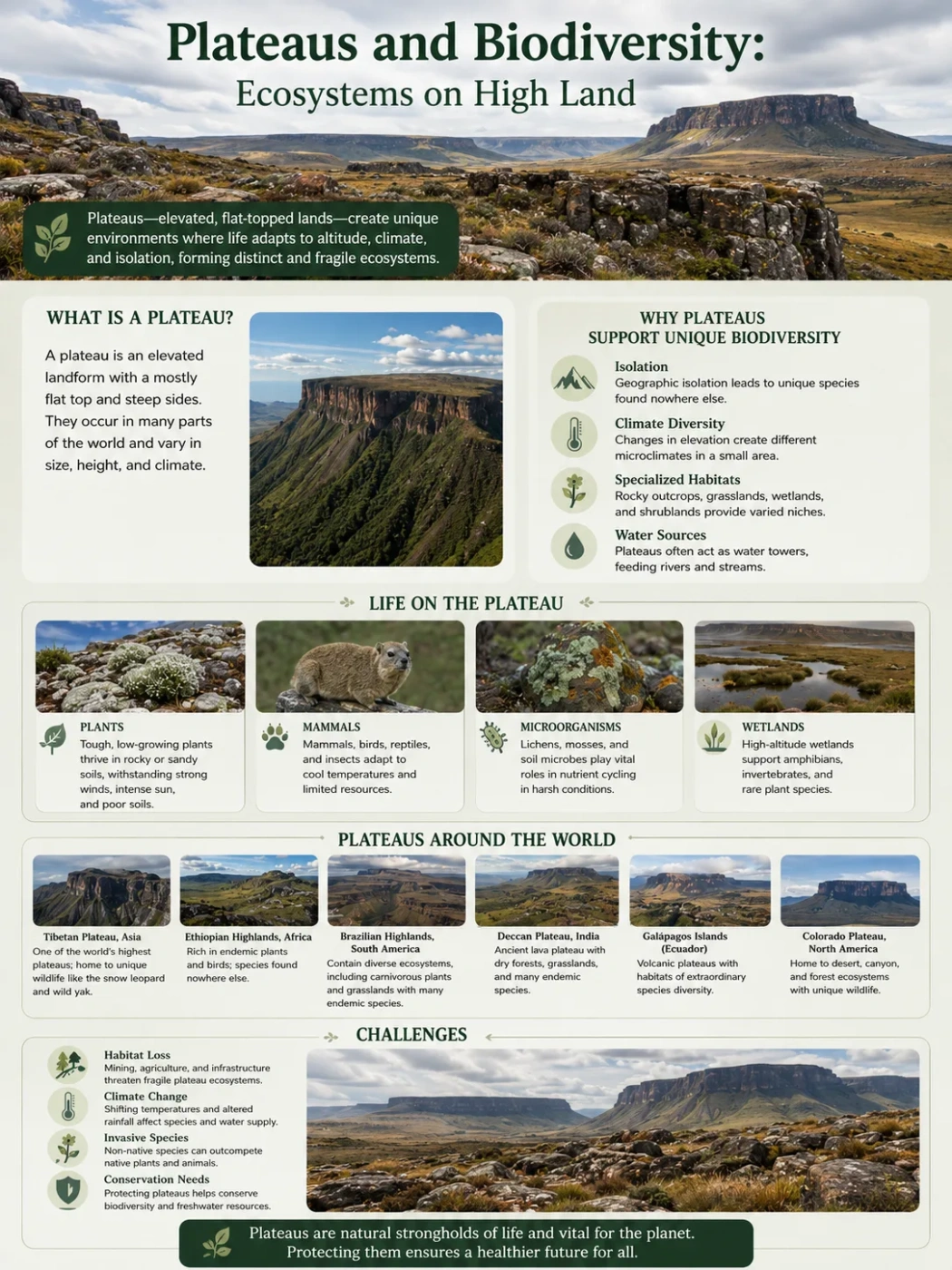
High plateaus often look open and simple from a distance: broad uplands, dry plains, grasslands, rocky rims, or cold tablelands. On the ground, they can hold a dense mix of habitats. A single plateau may include alpine meadows, steppe, wetlands, volcanic soils, river valleys, cliffs, forest edges, salt flats, and sheltered basins.
That variety is why biodiversity on high land is not just a mountain topic. Plateaus shape life through elevation, climate, drainage, isolation, soil, and landform edges. Their ecosystems often change over short distances, especially where flat uplands meet escarpments, canyons, lakes, or river headwaters.
| Plateau Feature | What It Changes | Common Ecosystem Result |
|---|---|---|
| Elevation | Temperature, growing season, oxygen, snow cover | Alpine grassland, meadow, shrubland, cold steppe, montane forest margins |
| Flat or Rolling Surface | Water movement, soil depth, grazing patterns | Grasslands, seasonal wetlands, peatlands, open rangelands |
| Escarpments and Canyon Edges | Slope, shade, rock exposure, drainage | Cliff plants, nesting habitats, dry woodlands, riparian corridors |
| Volcanic or Uplifted Geology | Soil chemistry, mineral content, drainage | Specialized plant communities, lava-field habitats, fertile highland soils |
| Basins and Closed Drainage | Salt, lake levels, wetland formation | Salt flats, reed beds, highland lakes, bird habitats |
| Distance from Oceans | Rainfall, humidity, seasonal range | Dry steppe, semi-arid shrubland, desert plateau ecosystems |
What Biodiversity Means on a Plateau
Biodiversity means the variety of living things in a place. On a plateau, it includes plants, animals, fungi, soil organisms, freshwater species, and the many habitats that support them.
A plateau ecosystem is not defined only by being high. It is shaped by the way elevation, surface shape, climate, rivers, and geology work together. A dry plateau at 1,500 meters can support very different life from a wet tropical plateau at the same height.
Three patterns matter most:
- Vertical change: higher land is usually cooler than nearby lowlands.
- Horizontal variety: flat uplands, cliffs, valleys, wetlands, and basins sit close together.
- Isolation: some plateau habitats are separated from similar habitats by lowlands, deserts, forests, or mountain chains.
This makes many plateaus ecological mosaics rather than single uniform landscapes.
Geography Note: A plateau can be flat in a broad landform sense while still containing hills, valleys, cliffs, wetlands, and river cuts. The term describes the raised surface as a whole, not a perfectly level floor.
Why High Land Creates Special Ecosystems
High plateaus change the basic conditions for life. Air is cooler, frost is more common, sunlight can be stronger, and growing seasons may be shorter. In many places, wind exposure and thin soils also limit which plants can survive.
These conditions often favor low-growing vegetation: grasses, sedges, cushion plants, shrubs, herbs, and hardy woodland species. In wetter highlands, forests may grow on slopes and sheltered valleys, while open plateau tops support grassland or heath.
Temperature and Growing Season
Temperature usually drops with altitude. That does not mean every plateau is cold, but it does mean a plateau can have a cooler climate than surrounding lowlands at the same latitude.
This cooler setting affects:
- when plants flower
- how long grasses can grow
- where trees can survive
- how insects and pollinators move through the year
- how snow, frost, and thaw cycles shape soils
On very high plateaus, plants often grow close to the ground. This helps them avoid wind damage and hold warmth near the soil surface.
Water, Drainage, and Wetlands
Plateaus can be dry, wet, or both in different places. A raised surface may lose water quickly through streams and canyons. Yet shallow basins, glacial hollows, lava depressions, and permafrost-influenced ground can hold water and form wetlands.
Highland wetlands are often small on a map but large in ecological value. They support amphibians, aquatic insects, sedges, mosses, migratory birds, grazing animals, and downstream river flow.
Soils and Rock Type
Plateau soils vary widely. Volcanic plateaus may have mineral-rich soils in some areas. Sandstone plateaus may be shallow, dry, and easily eroded. Limestone plateaus can hold caves, sinkholes, springs, and species adapted to alkaline soils.
Soil depth also matters. Deep soils may support grassland or farming. Thin soils on exposed rims may support sparse shrubs, lichens, and plants that tolerate drought.
Main Ecosystem Types Found on Plateaus
Plateaus do not have one standard ecosystem. Their habitats depend on latitude, elevation, rainfall, rock type, drainage, and nearby mountains or oceans.
| Ecosystem Type | Typical Setting | What It Supports |
|---|---|---|
| Alpine Meadow | Cold, high, often moist plateau zones | Low herbs, grasses, sedges, pollinators, grazing mammals |
| Highland Grassland | Open plateau surfaces with seasonal rainfall | Grasses, ground birds, grazing animals, soil organisms |
| Steppe and Semi-Arid Shrubland | Dry interior plateaus and rain-shadow regions | Drought-tolerant shrubs, grasses, reptiles, small mammals |
| Montane Forest Edge | Sheltered slopes, valley margins, wetter uplands | Trees, understory plants, birds, fungi, insects |
| Wetland and Peatland | Flat basins, spring zones, river headwaters | Sedges, mosses, amphibians, water birds, aquatic insects |
| Canyon and Escarpment Habitat | Plateau rims, cliffs, dissected valleys | Cliff plants, raptors, bats, shade-loving plants, riparian species |
| Volcanic Plateau Habitat | Lava fields, basalt plains, ash-derived soils | Specialized plants, grasslands, open woodlands, pioneer species |
Alpine Meadows
Alpine meadows form where high elevation limits tree growth but moisture is still available. They may look like simple grasslands, yet they often hold many small flowering plants, sedges, and insects adapted to short growing seasons.
These meadows can occur on very high plateaus, mountain-linked tablelands, and broad uplands near snow-fed streams. Their biodiversity often depends on soil moisture, snowmelt timing, and grazing pressure.
Highland Grasslands
Many plateaus support large grassland systems. These can be cold, tropical, dry, or seasonal. Grassland species often handle wind, frost, grazing, and fire better than trees.
Highland grasslands can also store carbon in their soils. Their roots help bind soil on open uplands where erosion could otherwise move quickly into river channels.
Wetlands and River Headwaters
Some of the most important plateau habitats are wet places: spring lines, peatlands, marshes, lake edges, and slow-moving headwater streams.
These areas often act like natural sponges. They hold water during wet periods and release it slowly into rivers. On high plateaus, this can affect people, farms, wildlife, and ecosystems far below the upland surface.
Escarpments, Canyons, and Rocky Rims
A plateau edge can create many habitats in a small area. A sun-facing cliff may be hot and dry. A shaded canyon wall may stay cooler and hold more moisture. A river corridor at the canyon floor may support trees, reeds, fish, and insects.
This is why dissected plateaus can be very diverse. The flat top, steep side, and valley bottom each create different living conditions.
Landform Note: A dissected plateau is a raised surface cut by rivers and erosion. Its biodiversity often follows the cuts: dry rims, shaded cliffs, stream valleys, springs, and canyon bottoms.
How Plateau Formation Affects Biodiversity
How a plateau forms can affect the ecosystems that grow on it. Formation controls rock type, slope, elevation, drainage, and soil development.
Tectonic Uplift
Some plateaus rise when large crustal blocks are lifted by tectonic forces. This can create broad highlands with strong elevation contrast from nearby lowlands. Over time, rivers cut into the surface and create valleys, terraces, and escarpments.
Uplifted plateaus often have varied climates across their surface. Windward sides may be wetter, while interior basins may be dry. This helps create different habitats within one plateau region.
Volcanic Activity
Volcanic plateaus form from repeated lava flows or widespread volcanic deposits. Basalt surfaces can weather into dark, mineral-rich soils, although young lava fields may remain rocky and thin-soiled.
Volcanic plateaus can support grasslands, open woodlands, shrublands, wetlands in depressions, and pioneer plants that colonize rough lava surfaces.
Erosion and Dissection
Many plateaus become more ecologically varied after rivers cut into them. Erosion creates canyons, mesas, buttes, cliffs, side valleys, springs, and slopes with different sun exposure.
This process can turn one raised tableland into a complex network of habitats.
| Plateau Formation | Landform Pattern | Biodiversity Effect |
|---|---|---|
| Tectonic Uplift | Large raised blocks, high plains, folded margins | Strong elevation zones, varied climate belts, isolated habitats |
| Volcanic Flows | Basalt plains, lava steps, volcanic soils | Grasslands, open woodlands, soil-driven plant communities |
| River Dissection | Canyons, mesas, cliffs, valley corridors | Sharp habitat contrast between rims, slopes, and stream floors |
| Basin Formation | Closed depressions, lakes, salt flats, wetlands | Waterbird habitat, salt-tolerant plants, aquatic biodiversity |
Plateaus as Islands of Habitat
Some plateau ecosystems work like ecological islands. They are not surrounded by ocean, but they may be separated by lower, warmer, drier, or more developed land.
This isolation can allow local species to adapt to narrow conditions. It can also make those species vulnerable if the habitat changes. A plant adapted to a cool, moist plateau top may have nowhere nearby to move if the plateau becomes warmer or drier.
Isolation is especially clear on:
- high tropical plateaus above warm lowlands
- dry plateaus bordered by deserts
- tablelands separated by deep canyons
- upland wetlands surrounded by grassland or steppe
- volcanic plateaus with unusual soils
This is one reason plateaus can support local plant communities that differ strongly from nearby plains.
Rivers, Basins, and Freshwater Biodiversity
Plateaus often sit at the start of river systems. Their raised surfaces collect rain, snowmelt, spring water, and wetland flow. Rivers then carry that water down to valleys, plains, lakes, and deltas.
Freshwater biodiversity on plateaus includes fish, amphibians, aquatic insects, algae, wetland plants, and riparian trees. Even small streams can matter because they connect upland habitats to larger basins.
Why Headwaters Matter
Headwaters are the uppermost parts of a river network. On plateaus, they may begin as springs, boggy meadows, snowmelt channels, or small streams cutting into the upland surface.
These waters help shape biodiversity in several ways:
- they create moist corridors through dry uplands
- they support insects that feed birds, fish, and amphibians
- they move nutrients from uplands to valleys
- they link wetlands, lakes, and river channels
- they form sheltered habitats in canyons and valley floors
Closed Basins and Lakes
Not all plateau water flows to the sea. Some plateaus contain closed basins where water collects in lakes, marshes, or salt flats. Evaporation can leave salts behind, creating habitats for salt-tolerant plants and specialized aquatic life.
Highland lakes can also become important bird habitats, especially in dry plateau regions where open water is limited.
Map Note: When reading a map, look for rivers that begin on a plateau and then cut outward through valleys or escarpments. These drainage lines often reveal where the most varied habitats occur.
Examples of Plateau Biodiversity Around the World
Different plateaus show different links between landform and life. Some are cold alpine systems. Some are dry tablelands. Others are tropical highlands, volcanic uplands, or canyon-cut landscapes.
| Plateau or Highland Region | Approximate Setting | Common Ecosystems | Biodiversity Link |
|---|---|---|---|
| Tibetan Plateau | Very high plateau of Central and East Asia, often above 4,000 meters | Alpine meadow, alpine steppe, wetlands, cold desert margins | Large headwater region with cold-adapted grassland and wetland systems |
| Altiplano-Puna | High Andean plateau region of western South America | Puna grassland, salt flats, highland lakes, shrubland | Dry highland basins support specialized plants and waterbird habitats |
| Ethiopian Highlands | High plateaus and mountain-linked uplands in northeast Africa | Montane grassland, forest remnants, afroalpine zones, river valleys | Elevation and isolation support many local species and headwater habitats |
| Colorado Plateau | Dissected plateau region of the southwestern United States | Pinyon-juniper woodland, desert shrubland, canyon riparian zones, mesa tops | Canyons and escarpments create strong habitat contrast over short distances |
| Deccan Plateau | Large peninsular plateau of India, much of it lower than alpine plateaus | Dry forest, scrub, grassland, river valleys, basalt-derived soils | Monsoon rainfall, lava geology, and rivers shape regional ecosystems |
| Brazilian Highlands | Broad uplands and plateaus of eastern and central Brazil | Savanna, forest patches, grassland, river headwaters | Relief, rainfall, and soils help shape varied tropical upland habitats |
| East African Plateau | Large elevated region connected to rifts, lakes, and volcanic highlands | Savanna, montane forest, wetlands, lake margins, grassland | Elevation, rift basins, and lakes create many habitat zones |
Tibetan Plateau: Alpine Grasslands and Headwaters
The Tibetan Plateau is often described as the highest and largest plateau region on Earth. Much of it lies above 4,000 meters. Its ecosystems include alpine meadow, alpine steppe, wetlands, cold desert, and highland lakes.
Its biodiversity is closely tied to water. Many river systems begin in or near this high plateau region, and wetlands help regulate headwater flow. Short growing seasons, cold air, frost, and grazing all shape the plant communities.
Altiplano-Puna: Dry Basins and Highland Lakes
The Altiplano-Puna region sits high in the central Andes. It includes dry basins, salt flats, volcanic landscapes, grasslands, and lakes. The climate can be cold and dry, with large day-night temperature shifts.
Here, biodiversity often gathers around water: lake edges, wetlands, springs, and moist grasslands. Salt-tolerant plants and highland birds are part of this plateau landscape.
Ethiopian Highlands: Isolation and Local Species
The Ethiopian Highlands include raised plateaus, escarpments, deep valleys, and very high uplands. Elevation creates cooler conditions than nearby lowlands, while steep relief separates habitats.
This region shows how plateaus and mountains can overlap. The broad highland surface supports farming, grasslands, forest remnants, afroalpine habitats, and river headwaters. Isolation has helped some species develop strong local ranges.
Colorado Plateau: Canyons, Mesas, and Dry Woodlands
The Colorado Plateau is a classic dissected plateau. Broad uplands are cut by canyons, mesas, buttes, cliffs, and river valleys. Its ecosystems include pinyon-juniper woodland, desert shrubland, grassland patches, riparian corridors, and cliff habitats.
Biodiversity here often follows topography. A mesa top, canyon wall, shaded alcove, and streambed can support different plants and animals even when they lie close together.
Deccan Plateau: Basalt, Monsoon, and River Valleys
The Deccan Plateau covers a large part of peninsular India. Much of it formed on ancient volcanic rocks, especially basalt. Its elevation is moderate compared with the Tibetan Plateau or the Altiplano, but it still shapes climate, drainage, soils, and vegetation.
Monsoon rainfall, dry-season stress, river valleys, forest patches, and open scrublands all affect biodiversity. The plateau shows that biodiversity on high land is not only about extreme altitude.
Plateau Biodiversity Is Not Always High
Not every plateau is rich in species. Some are cold, dry, salty, rocky, or wind-exposed. These conditions may limit the number of species while still supporting organisms that are highly adapted to the local environment.
A dry plateau may have fewer species than a wet forested lowland, but its species may be specialized. A cold alpine plateau may have low plant height and slow growth, yet it may hold rare wetlands, mosses, sedges, lichens, insects, and grazing-adapted vegetation.
So the better question is not “Do plateaus always have more biodiversity?” It is: What kind of biodiversity does this plateau support, and why?
Why Plateaus Often Have Endemic Species
Endemic species live naturally in one limited area. Some plateaus support endemism because their habitats are isolated, old, unusual, or sharply different from nearby lowlands.
Endemism can develop where:
- a plateau has unusual soils, such as volcanic, limestone, or saline soils
- cool highland habitats are separated by warmer lowlands
- deep valleys divide one plateau surface into smaller habitat blocks
- wetlands or lakes remain isolated for long periods
- plants and animals adapt to strong wind, frost, drought, or thin soil
Endemic species can make plateau regions important for conservation. They may also be sensitive to habitat loss because their range is small.
How Plateaus Shape Plant Life
Plants on plateaus must deal with elevation, soil, moisture, wind, frost, and sometimes strong sunlight. Their forms often reveal those conditions.
Common Plant Adaptations
- Low growth: helps plants avoid wind and hold warmth near the ground.
- Deep roots: help grasses and shrubs reach water in dry soils.
- Small leaves: reduce water loss in windy or dry settings.
- Cushion shape: protects plants in cold, exposed places.
- Seasonal dormancy: helps plants survive frost, drought, or dry seasons.
Why Grasslands Are Common
Grasslands are common on many plateaus because grasses can handle open terrain, grazing, frost, and seasonal water stress. Their roots also hold soil, which matters on uplands where erosion can feed sediment into rivers.
But plateau grassland is not one thing. It may be alpine meadow, dry steppe, tropical highland grassland, savanna, puna, or semi-arid rangeland depending on location.
How Plateaus Shape Animal Life
Animal life on plateaus follows food, shelter, water, and seasonal movement. Some species graze open uplands. Others nest on cliffs, use wetlands, move through river corridors, or shelter in rocky slopes.
Plateau animals may include:
- large grazers on grasslands and steppes
- small mammals that use burrows for warmth and safety
- birds that nest on cliffs or migrate through highland wetlands
- amphibians tied to springs, marshes, and headwater streams
- insects adapted to short flowering seasons
- reptiles in warmer, rocky plateau regions
Where plateaus meet mountains, animal ranges may shift with elevation. Where plateaus meet deserts, water points and shaded valleys often become local centers of life.
Human Life and Plateau Ecosystems
Many plateaus have supported human life for a long time because they offer open land, grazing areas, soils, mineral resources, cooler climates, and access to water. Some highlands are used for pastoralism. Others support farms, towns, roads, forests, protected areas, or tourism.
Human use can work with biodiversity or put pressure on it. The effect depends on intensity, land management, rainfall, soil type, and habitat sensitivity.
Common Human Connections
- Grazing: can maintain open grassland when balanced, but heavy pressure can reduce plant cover.
- Farming: often follows deeper soils, volcanic uplands, and river valleys.
- Water supply: plateau wetlands and headwaters can feed rivers used far downstream.
- Roads and settlements: can divide habitats and change drainage patterns.
- Protected areas: often focus on rare species, wetlands, canyon systems, and highland forests.
A plateau landscape is not separate from people. Its soils, grasses, forests, rivers, and wetlands often support both ecosystems and daily life.
Plateau Ecosystems vs Mountain Ecosystems
Plateaus and mountains often occur together, but they are not the same landform. A mountain is usually defined by steep relief and a summit. A plateau is a raised area with a broad upper surface, even if its edges are steep or deeply cut.
| Feature | Plateau Ecosystem | Mountain Ecosystem |
|---|---|---|
| Main Shape | Broad raised surface, often flat or rolling | Steep slopes, ridges, peaks, and valleys |
| Habitat Pattern | Large open uplands, rims, basins, headwaters, canyons | Strong vertical zones from base to summit |
| Water Pattern | Streams may begin on broad surfaces or wetlands, then cut outward | Streams often begin on slopes, glaciers, snowfields, or springs |
| Common Vegetation | Grassland, shrubland, steppe, meadow, woodland, wetland | Forest belts, alpine meadows, scree habitats, snow-edge communities |
| Common Confusion | High elevation makes it seem like a mountain region | Flat summit areas can resemble plateau surfaces |
The simple rule: a mountain rises to a peak; a plateau spreads as a raised surface. Both can support high-elevation biodiversity, but their habitat patterns differ.
Plateau Biodiversity vs Lowland Biodiversity
Lowlands often have warmer temperatures, longer growing seasons, and in many regions deeper soils. Plateaus may be cooler, windier, drier, rockier, or more seasonal. These differences shape the type of biodiversity present.
| Condition | High Plateau | Nearby Lowland |
|---|---|---|
| Temperature | Often cooler, with more frost risk | Often warmer, with longer growing seasons |
| Vegetation Height | Often lower in cold or dry zones | May support taller forest or denser vegetation where rainfall allows |
| Water | Headwaters, springs, wetlands, basins | Larger rivers, floodplains, lower lakes, deltas |
| Isolation | Can create local species and separated habitats | Often more connected across broad plains |
| Soils | May be thin, rocky, volcanic, saline, or frost-affected | May be deeper in valleys and floodplains |
Neither setting is automatically richer. A wet tropical lowland can hold many species, while a dry high plateau may hold fewer but more specialized species. A moist highland plateau can also be very diverse if it has forests, wetlands, escarpments, and varied soils.
How to Read Plateau Biodiversity on a Map
A map can show where biodiversity is likely to change across a plateau. The goal is not to count species from the map alone, but to notice landform clues.
Look for Elevation Bands
Contour lines or shaded relief show where the plateau rises, drops, or tilts. Higher zones may be cooler. Lower valleys may be warmer and wetter. Sharp elevation change often means habitat change.
Follow the Drainage Lines
Streams, rivers, marshes, and lakes often mark biodiversity corridors. On dry plateaus, even small drainage lines can support more plants and animals than the surrounding upland.
Mark the Edges
Escarpments, canyon rims, cliffs, and mesa edges create shade, shelter, nesting sites, and different soil depths. Plateau edges often hold more habitat contrast than the open center.
Notice Basins and Flats
Closed basins, salt flats, shallow lakes, and wetlands can support specialized communities. These areas may look plain on a map, but their water and chemistry often shape unique habitats.
Common Misconceptions About Plateaus and Biodiversity
Misconception 1: Plateaus Are Mostly Empty Land
Some plateaus look sparse, especially dry or cold ones. Sparse vegetation does not mean no biodiversity. Soil organisms, lichens, insects, shrubs, grasses, burrowing mammals, and seasonal wetlands may still form an active ecosystem.
Misconception 2: Higher Plateaus Always Have More Species
Elevation can create special habitats, but it can also limit life through cold, wind, drought, and short growing seasons. Species richness depends on moisture, latitude, soil, isolation, and habitat variety.
Misconception 3: Plateau Grasslands Are All the Same
Plateau grasslands differ widely. Alpine meadow, dry steppe, puna, savanna, and temperate upland grassland each form under different climate and soil conditions.
Misconception 4: Biodiversity Only Matters in Forests
Forests can be species-rich, but open plateau ecosystems also matter. Grasslands, shrublands, wetlands, cliffs, and river corridors support many plants and animals that do not depend on dense forest.
Why Plateau Biodiversity Can Be Vulnerable
Plateau ecosystems can be durable in some ways. Many species handle cold, drought, wind, grazing, or thin soils. Yet they can also be sensitive because recovery is often slow on high, dry, or cold land.
Common pressures include:
- loss of native vegetation
- wetland drainage or altered water flow
- soil erosion on open slopes and plateau rims
- heavy grazing in fragile grasslands
- road building through isolated habitats
- spread of non-native plants in disturbed areas
- warming conditions that shift plant and animal ranges upslope
Because many plateaus feed river systems, damage on the upland surface can move downstream through sediment, water quality changes, and altered seasonal flow.
Terms Often Confused with Plateau Biodiversity
| Term | Meaning | How It Relates to Plateaus |
|---|---|---|
| Highland | A broad term for elevated land | A plateau can be part of a highland region, but not all highlands are plateaus |
| Tableland | A raised landform with a broad, flat top | Often used as another word for plateau, especially in simple geography |
| Mesa | A flat-topped hill or small plateau with steep sides | Usually smaller than a plateau and often formed by erosion |
| Escarpment | A steep slope or cliff marking a sharp change in elevation | Often forms the edge of a plateau and creates habitat contrast |
| Montane Ecosystem | An ecosystem found in mountain or highland zones | May occur on plateau slopes, rims, and nearby mountains |
| Alpine Ecosystem | Cold, high-elevation ecosystem often above tree growth | Can occur on very high plateaus as well as mountains |
| River Basin | Land area drained by a river and its tributaries | Plateaus often contain headwaters that feed larger basins |
Mini FAQ
Why do plateaus have different ecosystems from nearby lowlands?
Plateaus are raised above surrounding land, so they often have cooler temperatures, different rainfall patterns, stronger winds, thinner soils, and shorter growing seasons. These conditions can support grasslands, shrublands, wetlands, alpine meadows, or dry steppe instead of the ecosystems found in nearby lowlands.
Are plateau ecosystems the same as mountain ecosystems?
No. They can overlap, especially in highland regions, but they are not the same. A mountain usually rises toward peaks and steep slopes, while a plateau spreads as a broad raised surface. Plateau ecosystems often include open uplands, basins, escarpments, canyons, and headwater wetlands.
Do all plateaus have high biodiversity?
No. Some plateaus are cold, dry, salty, rocky, or wind-exposed, so they may have fewer species. Others have high biodiversity because they include varied habitats such as wetlands, forests, grasslands, cliffs, river valleys, and isolated upland zones.
Why are grasslands common on plateaus?
Grasslands are common because grasses can handle open land, wind, grazing, frost, seasonal drought, and fire better than many trees. Plateau grasslands may be alpine meadow, dry steppe, tropical highland grassland, savanna, or puna depending on climate and elevation.
How do rivers affect biodiversity on plateaus?
Rivers and headwater streams create moist corridors across plateau landscapes. They support aquatic insects, fish, amphibians, riparian plants, birds, and mammals. In dry plateau regions, streams, springs, wetlands, and lake edges often hold more life than the surrounding upland.
What makes plateau species vulnerable?
Many plateau species live in narrow habitats such as cold meadows, wetlands, cliffs, volcanic soils, or isolated highland basins. If water flow, soil cover, grazing pressure, or temperature patterns change, these species may have limited nearby habitat to move into.