INTERACTIVE CONTEXT MAP
Dissected plateaus on the world map
30 relevant atlas locations are shown without loading the full world directory.
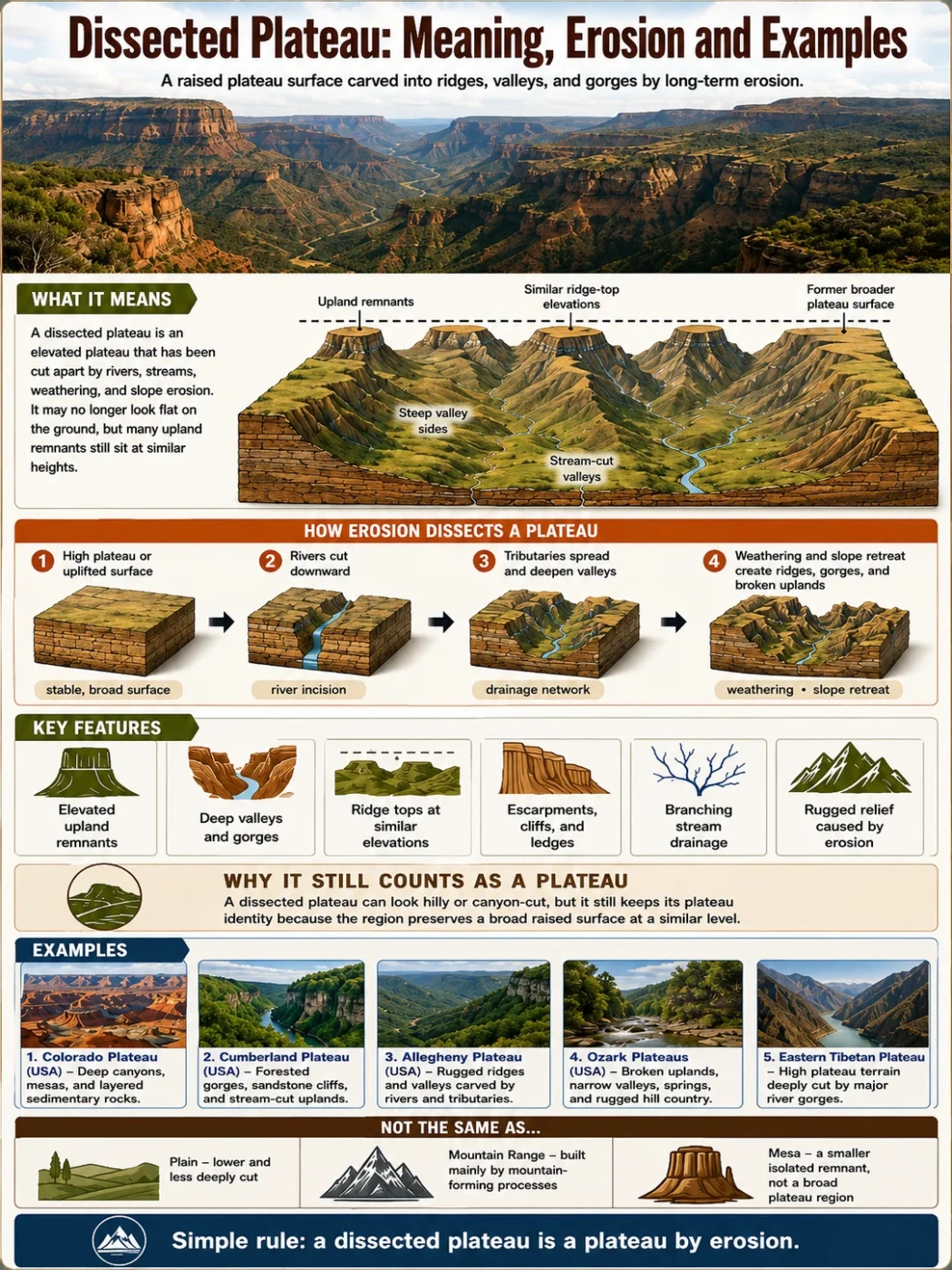
A dissected plateau is an elevated plateau surface that has been cut into by rivers, tributaries and slope erosion, producing valleys, gorges, ridges and isolated remnants of the older upland. The term describes the plateau’s present surface form, not the geological process that originally created the plateau.
What “Dissected” Means for a Plateau
Plateaus are often pictured as broad, nearly level uplands, but a plateau does not have to remain smooth. Once drainage becomes established, streams can cut downward through the elevated surface. Tributaries then extend into the surrounding upland, slopes retreat, and the original plateau surface becomes divided into progressively smaller pieces.
This distinction matters because dissection is not a separate geological origin. A tectonically raised plateau can be deeply dissected. A volcanic plateau built by lava flows can also become dissected after rivers begin cutting through it. A plateau can therefore be volcanic in origin, continental in setting and dissected in surface form at the same time.
Classification Distinction
Tectonic and volcanic usually describe how an upland developed. Intermontane or continental describe geographic setting. Dissected describes how strongly erosion has cut the present surface. These categories are not mutually exclusive.
A Plateau Can Remain a Plateau Without Looking Flat
Deep erosion can leave so little continuous level ground that the landscape begins to resemble a mountain region. The plateau identity may still be visible at a larger scale through surviving upland surfaces, broadly similar ridge-top elevations, structural benches or remnants of an older regional surface.
In strongly dissected terrain, the former plateau may survive mainly as interfluves and high ridge tops between valleys. A single ground-level photograph can therefore give a misleading impression. The plateau becomes easier to recognize when the terrain is viewed regionally on a topographic map, geological map or digital elevation model.
How Rivers Turn a Broad Upland Into Dissected Terrain
Dissection develops through a connected set of processes rather than one type of erosion. River incision creates the main vertical cuts, tributaries spread the drainage network through the upland, and weathering and mass movement reshape the slopes between channels.
Runoff concentrates into channels that carry water and sediment across the plateau surface.
Where rivers have enough erosive energy and vertical opportunity, channels cut downward and shallow valleys become deeper.
Side streams extend into the surrounding upland, dividing larger pieces of the plateau into narrower interfluves.
Weathering, runoff, rockfall, landsliding and other slope processes widen valleys and remove material exposed by incision.
With prolonged erosion, broad surviving surfaces may be reduced to ridges, benches, mesas or smaller upland remnants.
Why a River Cuts Downward
A river does not incise simply because it flows across a plateau. Downcutting depends on factors such as channel gradient, discharge, sediment load, bedrock resistance and the elevation difference available between the channel and its downstream base level.
Regional uplift can increase the potential for incision by raising land relative to the drainage outlet. A fall in downstream base level can have a similar effect. Drainage reorganization, river capture and tectonic deformation can also change channel gradients and alter where erosion becomes concentrated.
Uplift and Erosion Can Overlap
A simple diagram sometimes shows a plateau rising first and rivers cutting it much later. Real landscapes need not develop in two cleanly separated stages. Rivers can incise while uplift continues, drainage networks can adjust during deformation, and different parts of the same plateau can experience different histories.
This is especially relevant in large tectonic regions such as the Colorado Plateau, where river incision, fault movement, regional uplift and drainage development vary across space and time. The depth of a canyon should therefore not be treated automatically as a direct measurement of how much the entire plateau has risen.
What Controls the Depth and Pattern of Dissection?
Two plateaus exposed to erosion for long periods can develop very different surfaces. The resulting relief depends on how rivers interact with rock structure, climate, runoff, sediment and slope processes.
| Control | Effect on Erosion | Possible Landscape Expression |
|---|---|---|
| Relative uplift or base-level change | Can increase the vertical opportunity for rivers to cut downward | Deep valleys, canyons and greater local relief |
| River discharge and channel gradient | Affect the stream’s ability to transport sediment and erode its bed | Differences in valley depth and channel size |
| Resistant rock layers | Slow erosion where strong beds protect weaker material | Cliffs, benches, caprock and flat-topped remnants |
| Weak or easily eroded material | Allows channels and slopes to enlarge more rapidly | Dense gullies, wider valleys or rapidly retreating slopes |
| Joints, faults and fractures | Provide zones of weakness that erosion may follow | Aligned valleys, straight canyon segments and unstable cliff blocks |
| Runoff and rainfall pattern | Control how often and how strongly water moves across slopes and channels | Different drainage densities and rates of gully development |
| Mass wasting | Moves weathered or fractured material from steep slopes | Valley widening, slope retreat, rockfall and landslide terrain |
| Vegetation and soil cover | Modify runoff, infiltration and sediment supply | Different erosion responses even under similar regional climates |
Rock structure is especially visible where horizontal or gently inclined layers alternate between resistant and weaker beds. Rivers may cut through the sequence while resistant strata hold steep cliffs and weaker layers weather back into gentler slopes. Repetition of this process produces the stepped canyon walls and benches common in parts of the Colorado Plateau.
Other dissected surfaces develop differently. Thick loess, for example, can support dense networks of gullies rather than large bedrock canyons. The same descriptive term—dissected—can therefore apply to landscapes with very different geology.
Landforms Left Behind by Plateau Dissection
Incised Valleys and Gorges
Where vertical erosion is strong, rivers cut below the surrounding upland and create steep-sided valleys or gorges. Large trunk rivers may form the deepest cuts, while tributaries divide the intervening surface into smaller drainage blocks.
Ridges and Interfluves
An interfluve is the land between neighboring drainage channels. As tributary valleys grow toward one another, the intervening upland becomes narrower and may eventually resemble a ridge.
Such ridges should not automatically be interpreted as tectonically built mountain ridges. In some dissected plateaus, they are mainly erosional remnants left between valleys that cut into a once broader upland.
Cliffs, Benches and Stepped Slopes
Layered rocks can produce repeated breaks in slope. Resistant beds may hold cliffs or benches while weaker beds erode more readily. The resulting terrain records both river incision and differential erosion within the rock sequence.
Mesas and Isolated Plateau Remnants
Advanced dissection can separate surviving pieces of a plateau surface from the larger upland. Resistant caprock may help preserve flat-topped remnants such as mesas in suitable geological settings.
Mesas are not a required stage of plateau dissection. Their development depends strongly on geology, structure and erosion pattern, so many deeply dissected plateaus contain narrow ridges and irregular uplands instead.
Escarpments and Canyon Walls Are Not the Same Feature
A plateau may have a major escarpment along its regional margin while also containing steep walls created by rivers within its interior. Both can be visually dramatic, but they represent different positions in the landscape. An escarpment may mark a broad physiographic or structural boundary; an interior canyon wall forms along an incised drainage system.
Elevation Is Not a Measure of Dissection
Elevation measures height relative to a vertical reference such as mean sea level. Local relief measures the vertical difference between nearby high and low points. Dissection is much more closely expressed through local relief, valley depth and drainage pattern than through elevation alone.
High Plateau, Weak Dissection
- High elevation above sea level
- Broad surviving upland surface
- Relatively shallow valleys
- Lower local relief across short distances
Lower Plateau, Deep Dissection
- May sit at a lower absolute elevation
- Closely spaced valleys divide the surface
- Narrow ridges separate drainage basins
- High local relief can create mountain-like terrain
A plateau can therefore be very high yet comparatively smooth, while another plateau at lower elevation can be deeply cut and locally rugged. Statements such as “the higher plateau is more dissected” cannot be made from elevation values alone.
Can Plateau Dissection Be Measured?
There is no single worldwide numerical threshold that turns a plateau from “undissected” into “dissected.” Geomorphologists can quantify parts of the landscape, but the result depends on the scale of analysis, the selected terrain boundary and the resolution of the elevation data.
Useful measurements may include:
- Local relief: the vertical difference between nearby high and low terrain.
- Valley depth: how far channels lie below adjacent upland surfaces.
- Drainage density: the amount of channel length within a given area.
- Slope distribution: the proportion and arrangement of steep and gentle terrain.
- Ridge or interfluve spacing: how closely valleys divide the surviving upland.
- Hypsometric analysis: the distribution of land area across different elevations within a drainage basin or terrain unit.
- Terrain ruggedness measures: numerical descriptions of short-distance elevation variation.
Measurement Note
Terms such as weakly dissected, moderately dissected and deeply dissected can be useful descriptions, but they should not be assumed to represent one universal set of numeric classes. Results can change with map scale, DEM resolution and study method.
High-resolution elevation data have made active dissection easier to measure. On the Chinese Loess Plateau, for example, terrestrial laser scanning, satellite imagery and UAV-based surveys are used to measure gully retreat, slope change, erosion and sediment movement at scales that are difficult to capture from conventional topographic maps.
How to Recognize a Dissected Plateau on a Map
The strongest evidence usually comes from several terrain patterns viewed together rather than from one contour or one valley.
Look for Surviving High-Level Surfaces
Separate ridge tops or upland remnants may occur at broadly similar elevations even though deep valleys now lie between them. These remnants can preserve evidence of a more continuous regional surface.
Trace the Tributary Network
A dissected plateau commonly contains branching drainage systems that extend well into the upland. Closely spaced tributaries indicate that erosion has divided the surface into smaller interfluves.
Compare Valley Floors With Nearby Uplands
Tightly spaced contours along valleys indicate steep slopes. Large elevation differences between valley bottoms and nearby ridge tops reveal strong local relief and deep incision.
Use the Regional Pattern, Not One Cross-Section
A small map window may show only ridges and valleys and appear mountainous. A wider view may reveal that those ridges occupy a common elevated region bounded by lower terrain or by a recognizable plateau margin.
Shaded-relief maps and digital elevation models are especially useful because they reveal the drainage network and surviving upland surfaces together. Geological maps add another layer of evidence by showing whether cliffs, benches and ridges follow resistant strata, faults or other structural controls.
Dissected Plateau and Erosional Plateau Are Not Identical Terms
The two labels are sometimes treated as if they describe competing plateau types, but they answer different questions. Terminology varies among geography and geology sources, particularly for broad categories such as erosional, residual or denudational plateaus.
| Term | Main Question | What the Term Emphasizes |
|---|---|---|
| Dissected plateau | What has erosion done to the present plateau surface? | Valleys, gorges, ridges, drainage incision and fragmentation of the upland |
| Erosional or residual plateau | What role did long-term denudation or differential erosion play in developing the elevated landform? | Landform development, removal of surrounding material or preservation of resistant upland surfaces |
A plateau described as erosional in its development can also have a dissected present surface. Likewise, a plateau created primarily by tectonic uplift or volcanism may later become deeply dissected. Treating all of these labels as one mutually exclusive list hides the difference between origin and surface morphology.
Why a Dissected Plateau Can Resemble Mountains
Deep valleys reduce the amount of continuous upland visible from the ground. As tributaries approach one another, remaining interfluves become narrow, slopes become steeper, and the terrain may consist largely of ridges separated by valleys.
This creates a useful scale problem in landform classification. At the local scale, a ridge may look like an individual mountain. At the regional scale, the ridges may mark remnants of one plateau surface that has been divided by erosion.
The Appalachian Plateaus provide a clear example. In strongly dissected areas, steep-sided ridges and narrow valleys dominate the local landscape, while surviving summit levels and regional geology preserve the larger plateau relationship. In some parts of the province, only hilltops and upland remnants indicate the position of the former higher surface.
Landform Distinction
Rugged relief does not by itself make an area a mountain range. Classification also depends on regional structure, surviving surfaces, geological relationships and the scale at which the landform is being examined.
Examples of Dissected Plateaus
Colorado Plateau: Deep Incision Through Layered Rock
The Colorado Plateau of the southwestern United States is one of the clearest large-scale examples of plateau dissection. Rivers have cut deeply into a region containing broad sequences of sedimentary rock, exposing cliffs, benches and canyon walls while leaving mesas, buttes and larger plateau remnants between drainage systems.
The landscape also shows why “deeply dissected” should not be treated as a perfectly uniform regional label. Some sections contain extremely deep and dense canyon systems, while other plateau surfaces remain broader and less strongly cut. Geology, drainage history, volcanic cover, faulting and regional structure vary across the province.
The Colorado example is especially useful because erosion has not erased the plateau’s regional identity. Instead, deep canyon incision exists within a much larger elevated geological and physiographic province.
Cumberland and Appalachian Plateaus: A Plateau With Mountain-Like Relief
Parts of the Appalachian Plateaus in the eastern United States show a different style of dissection. Branching river systems have cut through sedimentary rocks to produce narrow valleys, steep slopes and irregular ridges. The Cumberland Plateau forms one of the better preserved plateau sections, while strongly dissected areas farther within the Appalachian Plateaus can appear distinctly mountainous.
Resistant sandstone beds can help hold upland surfaces and escarpments, while erosion of shale, limestone and other less resistant units influences valley form. In deeply cut areas, surviving hilltops may represent remnants of a once more continuous high-level surface.
Boston Mountains: A Dissected Tableland Within the Ozarks
The Boston Mountains of Arkansas and Oklahoma form the high southern part of the Ozark region. Despite the mountain name, their upper surface has long been described geologically as a strongly dissected tableland. Deep valleys separate elevated remnants and create the pronounced local relief associated with the region.
This example shows why landform names alone are unreliable guides to geomorphic classification. A region can carry a mountain name while its broader terrain structure records an elevated plateau or tableland that has been deeply cut by erosion.
Loess Plateau: Dense Gullies in Easily Eroded Sediment
China’s Loess Plateau shows a very different expression of dissection. Much of its surface is mantled by thick deposits of wind-blown silt known as loess. Water erosion can cut this material into dense systems of gullies, steep-sided channels and fragmented inter-gully uplands.
Gully development involves both flowing water and gravitational slope processes. Erosion at gully heads can extend channels into remaining upland, while erosion along gully walls and floors redistributes large amounts of sediment. Modern terrain surveys continue to document how rapidly individual gullies can change under different rainfall, vegetation and land-use conditions.
The Loess Plateau is useful for comparison with the Colorado Plateau because both can be strongly dissected without sharing the same geology or dominant landforms. One is widely associated with major bedrock canyons and resistant layered strata; the other demonstrates how dense dissection can develop in highly erodible sediment.
| Region | Characteristic Dissection | What the Example Shows |
|---|---|---|
| Colorado Plateau | Deep river canyons, cliffs, benches, mesas and buttes | Incision through a large elevated region with layered bedrock |
| Cumberland / Appalachian Plateaus | Narrow valleys, ravines and steep irregular ridges | How deep drainage dissection can produce mountain-like terrain |
| Boston Mountains | Deep valleys separating high tableland remnants | Why a dissected plateau may carry a mountain name |
| Loess Plateau | Dense gullies and fragmented inter-gully surfaces | Dissection of thick, easily eroded sediment rather than resistant bedrock |
| Yunnan–Guizhou Plateau | Strong river incision combined with rugged limestone and karst terrain | Interaction between drainage dissection and soluble-rock landscapes |
| Ethiopian Highlands | Deep valleys, gorges and escarpment-dominated relief | Strong dissection of an uplifted and extensively volcanic highland region |
How Far Can Dissection Progress?
Dissection is better understood as a continuum than as a fixed sequence with a mandatory end point. A plateau may retain large continuous surfaces, be divided into broad interfluves, or survive mainly as isolated upland remnants. The path depends on rock resistance, drainage history, climate, tectonic setting and the amount of time available for erosion.
Broad Upland
A large elevated surface remains continuous, with relatively shallow drainage.
Valley Incision
Main channels cut below the surface and establish stronger local relief.
Tributary Expansion
Branching valleys extend through the upland and narrow the surviving interfluves.
Deep Dissection
Ridges, gorges and steep slopes dominate much of the local terrain while remnants preserve the regional plateau relationship.
Isolated Remnants
Continued erosion may separate parts of the former upland into mesas, narrow ridges or scattered high-level remnants where geology allows.
Geomorphology Note
This progression is conceptual rather than a universal chronological model. Not every plateau passes through the same stages, develops mesas, or experiences uplift and erosion in the same order.
The defining idea is therefore not that a dissected plateau was once perfectly flat or that erosion follows one fixed pathway. It is that drainage and associated slope processes have cut into an elevated regional surface strongly enough to divide it into valleys and surviving upland remnants, while the broader plateau relationship remains recognizable.