INTERACTIVE CONTEXT MAP
Tectonic plateaus on the world map
14 relevant atlas locations are shown without loading the full world directory.
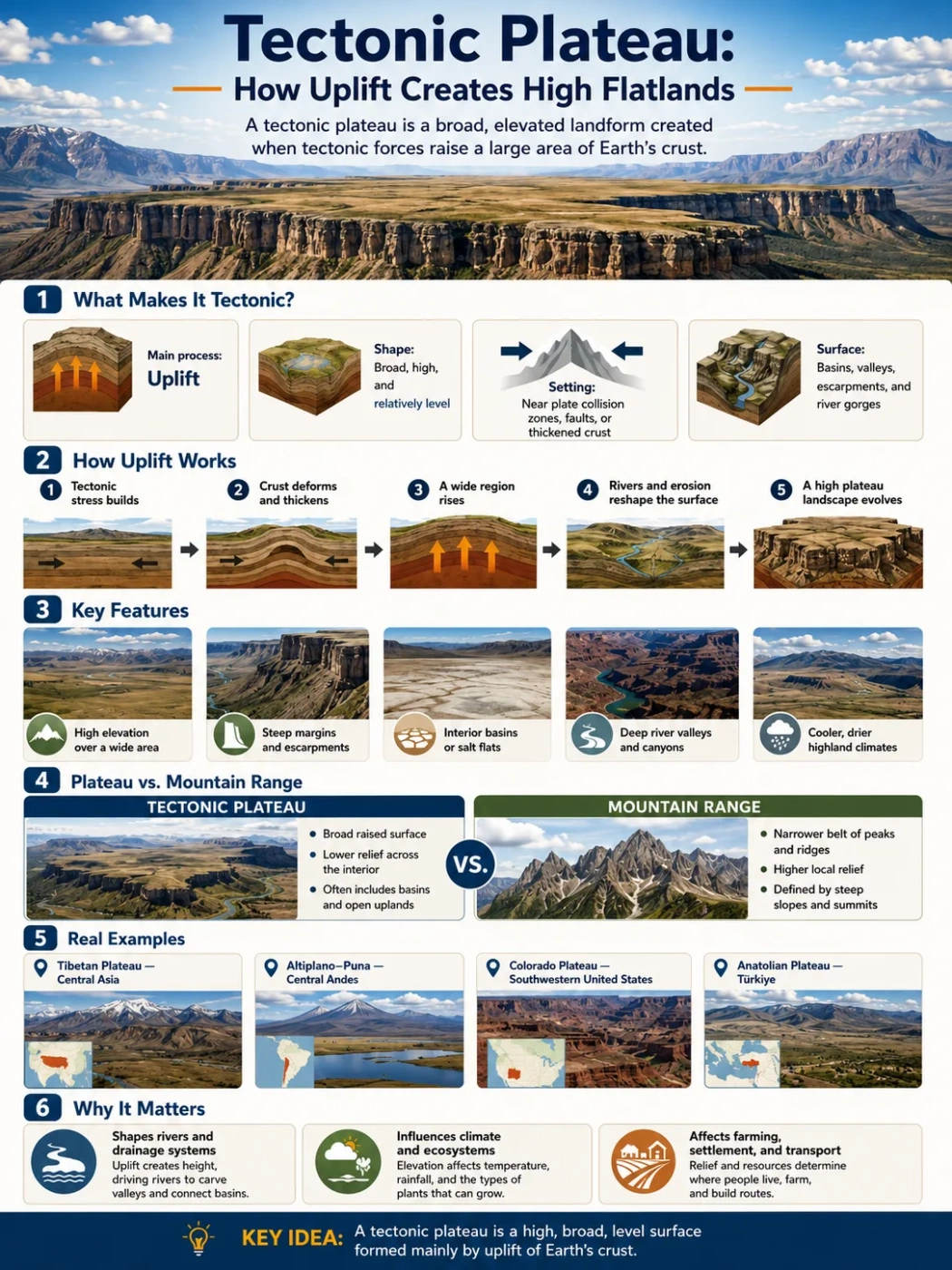
A tectonic plateau is a broad elevated region whose height is tied mainly to crustal deformation or deeper lithospheric processes. The important point is that tectonic uplift creates elevation, not automatic flatness. A high, plateau-like surface develops when broad uplift interacts with inherited topography, crustal structure, basin filling and erosion over large areas.
What Makes a Plateau Tectonic?
The term tectonic plateau describes origin rather than surface appearance. A plateau can be classified as tectonic when crustal movement and deformation are major reasons the region stands high above surrounding terrain.
This does not require a perfectly level surface. Large tectonic plateaus may contain mountain ranges, enclosed basins, fault scarps, river valleys and deeply dissected margins. What matters is the regional form: a broad elevated domain persists across an area much larger than an individual ridge or mountain.
Uplift and Flatness Are Different Problems
Tectonic forces can raise a landscape without making it flat. The plateau form depends on how widely deformation is distributed, what the landscape looked like before uplift, how sediments fill internal depressions, and how quickly erosion creates new relief.
This distinction explains why tectonic plateaus can look so different from one another. The Tibetan Plateau is a vast collision-related highland with mountain ranges and basins across its interior. The Colorado Plateau preserves large areas of comparatively modest internal deformation despite standing roughly 2 km above sea level on average. Both are tectonic plateaus, but their crustal histories and surface expressions are very different.
Why Uplift Can Produce High Flatlands Instead of One Mountain Range
A mountain belt and a plateau can both result from tectonic compression. The difference is partly a matter of scale and distribution of deformation.
Concentrated Deformation
- Shortening is focused into relatively narrow zones.
- Faults and folds create large local height differences.
- Closely spaced ridges and valleys produce strong relief.
- The regional form is more clearly mountain-belt-like.
Broad Regional Uplift
- Elevation gain extends across a much wider crustal region.
- High ground can continue for hundreds of kilometres.
- Interior basins and low-relief surfaces may occupy much of the elevated area.
- The resulting regional form can remain plateau-like even where mountains occur inside it.
Elevation Is Not the Same as Relief
Elevation measures how high a surface lies above a reference such as mean sea level. Relief describes the vertical difference between higher and lower parts of a landscape.
A broad basin at 4,000 m elevation can therefore have less local relief than rugged terrain at 1,500 m. This is central to understanding tectonic plateaus. They are not defined by the absence of mountains; they are regions where high average elevation extends across a broad area.
High local relief concentrated into ridges, peaks and valleys across a narrower zone.
High regional elevation spread across a broad surface that may contain lower-relief basins, uplands and internal ranges.
The Uplift Budget: Rock Can Rise Faster Than the Surface
One of the most useful distinctions in tectonic geomorphology is between rock uplift and surface uplift. They are not interchangeable.
The Basic Relationship
Surface uplift = rock uplift − exhumation
Rock may move upward tectonically while erosion and other denudational processes remove material from above it. The land surface therefore does not necessarily rise by the same amount as the underlying rock.
Rock Uplift
Rock uplift is the upward movement of a body of rock relative to a fixed reference level. Faulting, folding, crustal thickening and deeper geodynamic changes can all contribute to it.
Surface Uplift
Surface uplift is the actual increase in elevation of the topographic surface. It is the quantity that determines whether a landscape is becoming higher.
Exhumation
Exhumation is the movement of rock toward Earth’s surface relative to the surface itself. Erosion commonly drives it by stripping away overlying rock and sediment, although tectonic unroofing can also contribute.
This relationship resolves an apparent contradiction seen on many plateaus: rocks can continue moving upward while rivers simultaneously cut valleys deeper into the landscape. A plateau can therefore experience tectonic uplift and strong erosional lowering at the same time.
| Balance | Likely Surface Response |
|---|---|
| Rock uplift exceeds exhumation | Mean surface elevation can increase. |
| Rock uplift and exhumation are similar | The landscape may remain at broadly similar elevation while rock continues to move upward through the system. |
| Exhumation exceeds rock uplift | The surface can lose elevation even while tectonic uplift continues. |
The Deep Processes That Can Raise a Plateau
There is no single tectonic mechanism that explains every high plateau. Some are closely tied to continent-continent collision, others to subduction-related deformation, broad lithospheric buoyancy changes, mantle processes or uplift of relatively coherent crustal blocks. Several mechanisms can also operate in the same region at different times.
Horizontal compression can shorten the crust and increase its thickness. Because continental crust is less dense than the mantle beneath it, a thick crustal column can support high regional topography.
During continental convergence, one crustal or lithospheric body may extend beneath another. The resulting addition and rearrangement of material at depth can contribute to crustal thickening and uplift.
Hot, mechanically weak crust at depth may deform differently from the brittle upper crust. Lateral redistribution of this material can help thicken crust and spread deformation beyond the most obvious surface faults.
Dense lower lithosphere may detach, peel away or founder into the mantle. Replacing dense material with hotter, more buoyant asthenosphere can change the support of the overlying surface and contribute to uplift.
Magma does not have to erupt as lava to affect a plateau. Intrusion and underplating at the base or within the crust can alter crustal thickness, temperature and density, linking tectonic and magmatic processes.
Crustal Thickening and Isostatic Support
Continental collision provides the clearest example of broad crustal thickening. When two buoyant continental masses converge, neither behaves like dense oceanic lithosphere that can readily descend into the mantle. The crust instead shortens, faults, folds and thickens.
A thicker column of continental crust can develop a deeper crustal root while supporting a higher surface, much as differences in density and thickness help determine how material floats in a denser medium. This isostatic relationship is important, but real plateaus cannot be reduced to a simple floating-block model. Temperature, mantle structure, deformation, erosion and magmatism can change the density and mechanical behaviour of the lithosphere.
Deep Deformation Does Not Always Match Surface Deformation
Some plateau-growth models allow the middle or lower crust to deform and redistribute material over broad distances while the upper crust responds differently. This helps explain why a high region does not need to display the same degree of folding or faulting everywhere at the surface.
Seismic imaging across Tibet continues to test this idea. Research published in 2025 identified contrasting regions interpreted as different stages of middle-crustal-flow-related plateau development, including areas where deep crustal changes appear without equally developed large-scale surface uplift. Work published in 2026 on the northeastern plateau margin likewise links present deformation to structures in the middle and lower crust. These findings support a view of plateau growth as spatially uneven rather than one synchronized rise of an entire continent-sized surface.
Removal of Dense Lithosphere Can Change Surface Height
Crustal thickening is also not the only route to high topography. If dense mantle lithosphere sinks or separates from the overlying plate, the remaining lithosphere can become more buoyant. Hot asthenospheric material may move upward into the space left behind, changing temperatures, density and magmatism as well as elevation.
Models for both Tibet and the Central Andes include forms of lithospheric delamination or foundering, although the importance, timing and geometry of these processes remain active research questions rather than a universal explanation for tectonic plateaus.
No Single Plateau-Uplift Mechanism Fits Every Region
Collision, shortening, crustal flow, magmatism, lithospheric removal and mantle-driven support are not competing labels from which every plateau must receive exactly one. Large tectonic plateaus can record several processes acting at different depths and at different stages of their development.
Why the Surface Can Stay Broad and Relatively Flat
Explaining elevation is only half of the tectonic-plateau problem. The harder question is why a region undergoing major deformation can retain extensive areas of comparatively low relief.
An Older Low-Relief Landscape Can Be Raised
Uplift does not have to construct a new flat surface. In some settings, a broad landscape that already had relatively low relief can be raised while much of its regional geometry survives.
If deformation occurs over a long horizontal wavelength, the whole surface may gain elevation without being transformed into a closely spaced field of sharp ridges. Later erosion can dissect that inherited surface without immediately removing its plateau-scale identity.
Broad Deformation Produces Long-Wavelength Topography
A narrow fault can generate a steep local escarpment. A change involving a much larger lithospheric column can produce elevation differences distributed across hundreds of kilometres. The second form of deformation is better suited to producing the broad topographic swell associated with many tectonic plateaus.
The Colorado Plateau illustrates why this matters. Much of its surface is underlain by sedimentary rocks that remain comparatively gently deformed, yet the region stands at high average elevation. A 2025 assessment described the process and timing responsible for its broad surface uplift as still unresolved and discussed lithospheric density changes and mantle-related dynamic support among the mechanisms capable of producing long-wavelength uplift with limited internal deformation.
Interior Basins Can Reduce Topographic Roughness
Plateau interiors are not necessarily continuous rock platforms. Tectonic deformation can create depressions between ranges and uplifted blocks. Those basins may receive sediment eroded from nearby high ground.
Over long periods, river sediment, lake deposits, alluvial fans, wind-blown material and volcanic deposits can partially fill depressions. Basin filling does not make the entire plateau flat, but it can create broad low-gradient surfaces between more rugged uplands.
Faulting, folding or crustal deformation creates ranges and depressions within the rising region.
Weathering and erosion move material from steeper uplands toward adjacent basins.
Sediment occupies depressions and creates broad basin floors within the elevated terrain.
Mountains can remain above the basin floors while the wider region still forms one extensive highland.
Erosion Can Smooth Relief and Create It
Erosion has two apparently opposite effects on plateau topography. It removes high points and can reduce relief, but rivers can also cut deeply into an uplifted surface and create canyons, steep valley walls and dissected margins.
Which effect dominates depends on rock strength, drainage, climate, uplift history and the amount of time available. A relatively smooth plateau interior and a deeply incised plateau edge can therefore be parts of the same evolving landform.
What Rivers Do When a Plateau Rises
Rivers provide one of the clearest surface responses to tectonic uplift. If land along a river course rises relative to its downstream base level, the channel may gain gradient and erosive potential. Instead of simply flowing across the elevated surface, it can begin cutting into it.
Incision Turns a High Surface Into a Dissected One
Continued downcutting creates valleys and canyons while remnants of the older high surface remain between them. This is why a tectonically raised plateau may eventually look rugged even though broad remnants of its regional surface are still recognizable.
The Colorado Plateau is an especially clear example of uplift followed by major river incision. USGS descriptions of the region note that uplift steepened stream gradients and accelerated downcutting by the Colorado River and its tributaries, exposing thick sequences of sedimentary rock.
Knickpoints Record a River Out of Equilibrium
A river profile is not always a smooth curve from headwaters to outlet. A relatively steep reach or abrupt change in channel gradient is called a knickpoint or, when it extends across a reach, a knickzone.
Knickpoints can form after tectonic displacement, a drop in downstream base level, river capture or contrasts in bedrock resistance. They may migrate upstream as the river adjusts. Their presence can therefore reveal that a drainage system is responding to change, but a knickpoint by itself does not prove tectonic uplift.
Uplift Can Reorganize Entire Drainage Networks
Large-scale deformation can shift watersheds, reverse local drainage, isolate interior basins or redirect rivers toward new outlets. River capture can connect drainage systems that were once separate.
This distinction matters when reconstructing plateau history. Canyon cutting can result from surface uplift, but it can also accelerate after drainage integration lowers effective base level. On the Colorado Plateau, modern work continues to separate the effects of plateau uplift from later integration and incision of the Colorado River system.
How Geologists Detect Tectonic Plateau Uplift
A present-day high surface does not reveal by itself when it rose or what drove the uplift. Geologists combine evidence from rocks, landforms, mineral cooling histories, ancient environments, geodesy and the structure of the crust and mantle.
| Evidence | What It Can Reveal | Important Limitation |
|---|---|---|
| Faults, folds and deformed strata | Where crust shortened, tilted, fractured or moved vertically | Surface structures may record only part of deeper deformation. |
| Former marine or lowland deposits now at high elevation | That rocks or surfaces have experienced large vertical displacement since deposition | The present elevation alone does not determine exactly when uplift occurred. |
| River terraces and incised valleys | Changes in relative river level, incision and landscape adjustment | Incision can respond to base-level change as well as tectonic uplift. |
| Thermochronology | When rocks cooled as they moved toward the surface | Cooling histories primarily constrain exhumation and require modelling to relate them to surface uplift. |
| Paleoelevation proxies | Past surface elevation inferred from environmental, fossil, soil or geochemical records | Different proxies can have different uncertainties and spatial scales. |
| GPS and InSAR | Present-day crustal motion and vertical deformation | Modern rates may not represent the long-term geological average. |
| Seismic imaging | Crustal thickness, velocity structure, plate geometry and possible zones of weak or partially molten crust | Subsurface structures can allow more than one geodynamic interpretation. |
High Marine Rocks Show Vertical Displacement, Not a Complete Uplift History
Marine sedimentary rocks found far above sea level provide intuitive evidence that the crust containing them has changed elevation since deposition. The Colorado Plateau contains sedimentary strata deposited in marine and other low-elevation environments that now occur at high elevations.
Such evidence establishes major vertical change but does not, by itself, identify the responsible mantle process or determine whether all of the elevation gain happened during one event. That requires other records.
Thermochronology Tracks Exhumation Through Temperature
Minerals contain temperature-sensitive isotopic systems that change or become retained as rocks cool. Because temperature generally increases with depth in the crust, mineral cooling ages can help reconstruct when rock moved toward the surface.
Thermochronology is therefore especially useful for estimating exhumation histories. It should not be treated as a direct altimeter: rapid erosion can expose deeper rocks without an equivalent rise in surface elevation.
Paleoelevation Proxies Ask How High the Surface Used to Be
Fossil vegetation, ancient soils, lake deposits and stable-isotope records can preserve information related to past elevation and environment. These records have changed interpretations of several major plateau systems by showing that different sectors may have reached high elevations at different times.
Southern Tibet illustrates the issue. Evidence synthesized in recent research indicates that parts of the Gangdese region may already have exceeded about 4 km elevation before or around the main India-Asia collision interval, complicating any model in which the entire modern plateau simply rose as one surface after collision.
Seismic Waves Reveal the Structure Supporting the Surface
Earthquake waves change speed and direction as they pass through materials with different properties. Dense seismic networks can therefore image features such as crustal thickness, the crust-mantle boundary, descending lithosphere and unusually low-velocity zones within the crust.
Those observations connect surface geography with deep Earth structure. They are especially important in Tibet, where current models test combinations of underthrusting, crustal thickening, middle-crustal deformation, partial melting and lithospheric removal rather than relying on a single visible surface structure.
Three Plateaus Show Why “Tectonic” Is Not One Formation Recipe
Tectonic plateaus are most useful to compare by the processes that support their elevation and the ways their surfaces respond. Tibet, the Central Andes and the Colorado Plateau represent three different versions of the same broad landform problem.
| Plateau System | Central Tectonic Problem | Why It Has a Plateau-Scale Surface | Important Surface Modification |
|---|---|---|---|
| Tibetan Plateau | Continental collision, crustal shortening and thickening, underthrusting and deeper crust-mantle processes | Exceptional crustal thickness and regional high elevation extend across an enormous collision zone containing broad interior basins as well as mountain ranges. | Faulting, river incision, glaciers and basin sedimentation continually reshape the high surface. |
| Altiplano-Puna / Central Andean Plateau | Subduction-related shortening and crustal thickening combined with magmatism and lithospheric removal in parts of the system | Ranges and high basins together form a broad elevated region rather than one narrow mountain ridge. | Internal drainage, basin sedimentation, volcanism and erosion create large contrasts within the plateau. |
| Colorado Plateau | Long-wavelength surface uplift with relatively limited internal crustal shortening; the exact uplift mechanism remains debated | Large tracts of sedimentary strata remained comparatively gently deformed as the wider region gained elevation. | Integration and incision of the Colorado River system produced deep canyons and strongly dissected parts of the plateau. |
Tibet: A Plateau Built Across a Continental Collision Zone
The Tibetan Plateau shows why a tectonic plateau should not be imagined as a simple fault block pushed upward. India-Eurasia convergence has produced crustal shortening, exceptional crustal thickness, major fault systems, internal mountain ranges and broad high basins across a region exceeding 2.5 million km². Parts of its crust reach roughly 80 km in thickness.
The continuing debate concerns how those elements developed through space and time. Proposed and tested processes include shortening and thickening, Indian lithospheric underthrusting, lateral deformation of weak middle crust, mantle delamination and magmatic addition. Recent observations increasingly show that different sectors need not have followed the same uplift history.
The Central Andes: High Basins Inside an Active Orogen
The Altiplano-Puna region demonstrates another route to plateau-scale topography. It occupies the wider Central Andean orogenic system, where crustal shortening and thickening occur alongside extensive magmatism and evidence for changes in the underlying lithosphere.
High sedimentary basins between mountain ranges are essential to its plateau character. The regional surface is therefore not flat in the everyday sense. It is a broad high-elevation domain assembled from ranges, basins, volcanic terrain and internally drained areas.
Geodynamic experiments and observations from parts of the Central Andes also support episodes in which sinking or removal of dense lithosphere can be associated with subsidence followed by rapid surface uplift, showing that plateau evolution can involve vertical reversals rather than steady elevation gain.
The Colorado Plateau: High Without Becoming a Typical Fold-and-Thrust Belt
The Colorado Plateau exposes a different problem. Much of the province retains gently deformed sedimentary rocks compared with surrounding mountain belts, yet its average elevation is about 2,000 m. Local folds, monoclines and faults exist, but the amount of crustal shortening visible across the plateau does not by itself explain the region’s present height.
This has kept attention on long-wavelength uplift processes related to lithospheric temperature, composition, thickness, mantle flow and isostatic responses to erosion. The timing and relative importance of those processes remain debated.
The region also demonstrates why uplift and present surface form must be separated. River erosion has carved deep canyons through an uplifted tectonic unit while large remnants of the broader high surface remain between the drainage systems.
A Tectonic Plateau Can Also Be a Dissected Plateau
Tectonic and dissected describe different dimensions of a landform. Tectonic refers to how elevation developed. Dissected describes what erosion has subsequently done to the surface.
A plateau may therefore begin as a broadly uplifted surface and later acquire deep valleys, canyons and isolated remnants without losing its regional plateau identity.
A large crustal region gains elevation through tectonic or deeper geodynamic processes.
Inherited low-relief terrain and sediment-filled basins can preserve extensive gentler surfaces within the highland.
Rivers steepen, integrate or shift course as elevation and downstream base levels change.
Valleys and canyons cut into the elevated surface, especially along established drainage routes and plateau margins.
Broad remnants of the original high surface remain separated by increasingly deep erosional relief.
This process can continue for millions of years while tectonic forcing is still active. If rock uplift keeps pace with erosion, rivers may cut downward without eliminating the plateau’s regional elevation. If uplift weakens while denudation continues, the high surface becomes progressively more fragmented, leaving ridges, mesas, isolated remnants and deeply dissected uplands where a broader surface once existed.